Building a Daily Japanese Study Routine That Sticks
 2 phút đọc
 22 lượt xem
 2 phút đọc22 lượt xem
A Japanese study routine beats motivation every time. Motivation comes and goes, whereas a routine keeps working on the days you do not feel like it. Thirty minutes daily will take you further than one long weekend session.
This post gives you a block you can run today, plus the habits that keep it alive after the first month.
Why consistency beats intensity
Memory fades on a curve. Reviewing just before you forget resets that curve, which is the core idea behind spaced repetition. Therefore, daily contact is worth more than the same hours in one sitting.
There is a second reason. Long sessions are easy to cancel. A short session is hard to justify skipping, so it survives busy weeks.
A thirty minute Japanese study routine
Minutes 1 to 10 — new grammar
Study one new pattern. Read the explanation, then write three of your own sentences. One pattern a day is roughly three hundred a year.
Minutes 11 to 20 — review
Go back over yesterday's pattern and last week's errors. Review is where the learning actually consolidates, although it feels less exciting than new material.
Minutes 21 to 30 — input
Read or listen to something slightly above your level. For example, a graded reader or a short news clip works well.
Where the routine usually breaks
Most routines fail for predictable reasons. First, the session is too long. Second, it has no fixed time. Third, it depends on feeling ready.
Fix all three at once. Pick a fixed slot, keep it short, and start even when you are tired. As a result, the habit survives the weeks when everything else is busy.
Track it, but keep tracking cheap
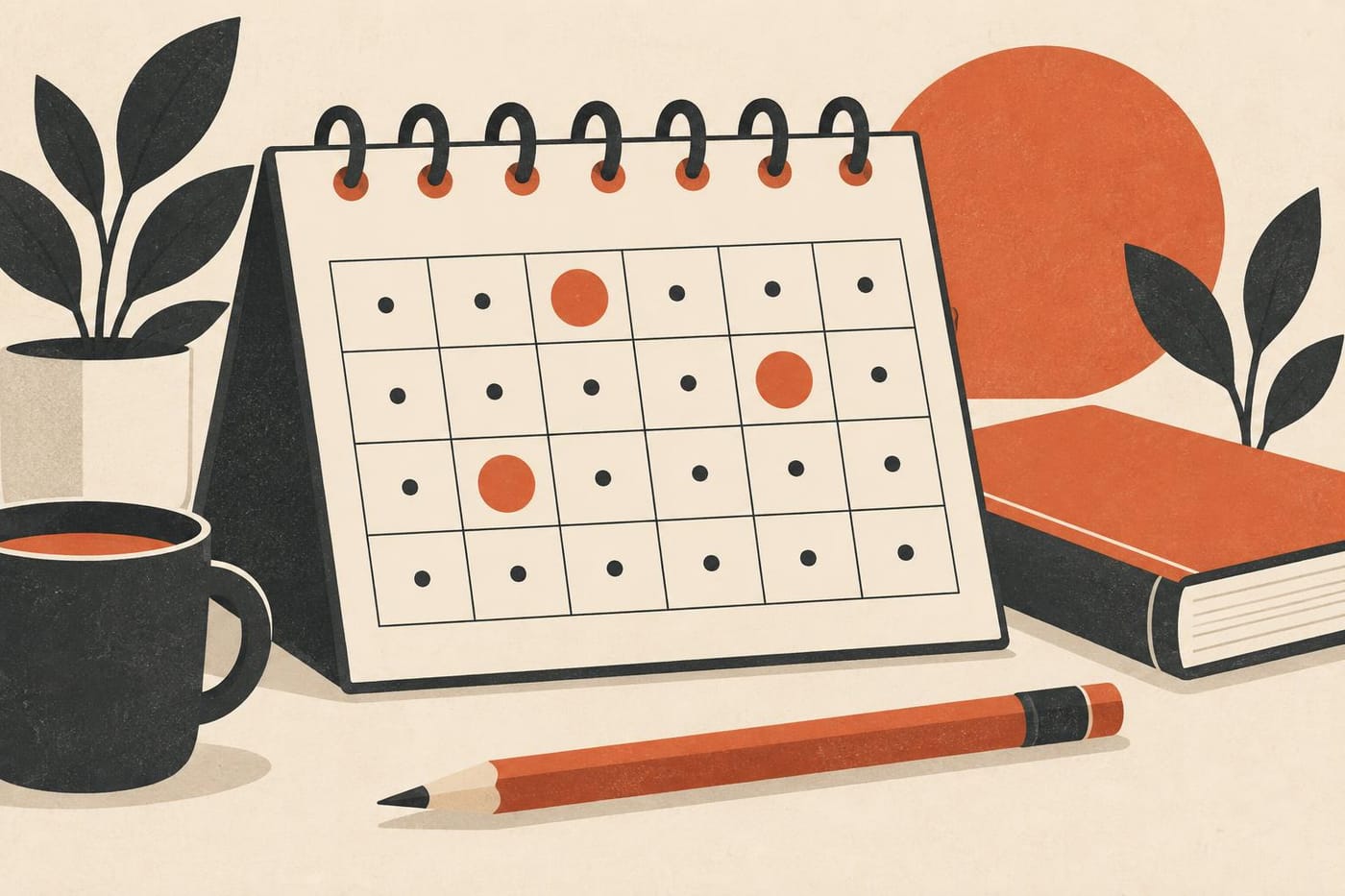
A simple streak is enough. Mark the day when you finish. Because the mark is visible, missing feels costly.
Nevertheless, do not let a broken streak end the habit. Miss one day and continue. Miss two and you are rebuilding from scratch, so protect the second day above all.
Fitting the routine into a real week
Weekdays and weekends need different plans. On busy days, run only the first ten minutes. Meanwhile, use the weekend for a longer reading session or a mock test.
- Commute — listening practice
- Lunch break — a quick grammar quiz
- Evening — the full thirty minute block
Splitting the block is fine. In fact, three ten minute sessions often beat one long one, because each restart forces recall.
What to study inside the routine
Follow a fixed sequence rather than choosing daily. Choosing costs willpower you would rather spend studying. Our grammar library is ordered by JLPT level, so the next item is always obvious.
If you are preparing for an exam, our JLPT study plan shows how to weight each section. For beginners, start with the first month of grammar.
Give the routine three months
Progress in Japanese is slow at first and then accelerates. Consequently, judging your routine after two weeks is unfair to it. Three months is a fair test.
Keep the sessions small, keep them daily, and let the calendar do the work. A modest Japanese study routine that you actually run will beat an ambitious one that you abandon.
 0 thích